Posts

The Question

As someone who writes and speaks openly about serious mental health issues and my experience, I do get asked many questions. Some of the questions are constructive, like how to find help or support and other questions are asked about how I deal with mental illness. Occassionally, I get asked very personal questions, and I try my best to keep boundries. I understand that answering questions will lead to a better understanding about mental illness which will end the stigma. Of the hundreds of questions I've been asked, one situation stands out that gave me clarity to how a lot of people view mental illness. I was away at a workshop where I had read my story and helped the audience learn the storytelling process. At the end of the day, after speaking with many people interested in mental health, a man came up to me as I was getting my things together to head back to the hotel. I assumed it was just someone saying that he liked the workshop or the piece I read. In...
The 8 most important lessons I learned as a 23-year-old

Last week, I celebrated my 24th birthday! I have spent a lot of time over the past few days reflecting on the past year. At this time last year, I was having a difficult time accepting myself. Going back to school didn't go as I had planned, I was 20 pounds heavier, it was the first birthday being single since I was in high school, and I wasn't sure what I wanted to do with my life. I dreaded going to local stores and restaurants because I was afraid I would run into someone I knew from the past, and I wouldn't know what to say if they asked what I've been up to. I'm glad that I stayed hopeful, because 23 ended up being the most exciting and transforming year of my life. It was the year that I took the most chances, and learned the most about myself and the world around me. Here are the 8 most important lessons I learned as a 23-year-old: (Warning: Some of these are extremely cliché but still very true.) 1. I would much rather be single than be in the wrong rel...

TMI in Buffalo

Image
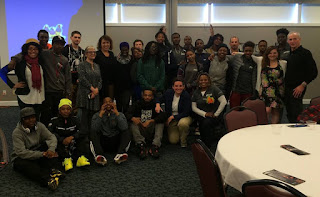
I'm sitting in my hotel room in Buffalo and trying to process all that has happened on my short trip. Several weeks ago, I had been asked by Eva and Sari, the directors of the TMI Project, to join them on a trip to Buffalo to read my piece about my journey with mental illness at their writing workshop. Getting the chance to travel AND discuss mental illness? I responded "yes" just nanoseconds after I got the email. My mom and I took the nearly 7-hour train ride, and I got to see Western New York for the first time. Buffalo has been even more amazing than I thought it would be. This morning, I met up with the two TMI Project directors and the other readers, Ray and Valerie. We were picked up by members of The Service Collaborative of Western New York (Thank you Hannah!) and all headed to the University at Buffalo for the workshop. This specific TMI workshop was for several groups, including AmeriCorps. In all, there were approximately 150 people, mostly young...

Hospitalization: Part 1

A major part of my mental health journey occurred between June and December of 2013. During this time, I was hospitalized 5 times, spending nearly 3 months total in the hospital. Since my psychiatric disorder was so sudden and severe, I had to have multiple tests done, medication adjustments, and diagnostic evaluations. For a long time, I kept that part of my story private. Only my close friends, close family, and therapists knew. I thought if people found out, they would make judgments, avoid speaking to me, or change their minds about the kind of person I am. I joined a writing group in the fall of 2015 called the TMI Project where we wrote about the stories in our lives that we were afraid to tell. It was the first time I was opening up to people about the subject. The night before the public reading of our pieces, I got really nervous. I said to my mom, "People might think I'm a loser." She replied, "Allie, people will think you're a hero." From that m...

Feeling the fire again

Before mental illness, I had no problem speaking up for myself or for a loved one if I felt we were being mistreated. For the past couple years, I had lost that confidence. Last Friday, I surprised myself when I felt some of that fire coming back. My service dog Joey and I had just left therapy and were meeting my cousin Ellen for lunch at a fast food restaurant that we go to often. Fast food restaurants tend to be a triggering place for me. Joey had been there before, more than 5 times, and he knew exactly what to do; when we picked out our table, he quietly tucked under the table at my feet. As I was taking out my wallet, the manager of the restaurant approached us. I wasn't alarmed or suspicious because people come up to compliment Joey whenever we are out. To my surprise, he asked if he could see Joey's service dog certification. I was taken off guard but explained that service dogs don't have a certification. Service dogs are trained to do tasks catered to their ha...

Lick Stigma!

Image
The Merriam-Webster Dictionary defines stigma as, “a set of negative and often unfair beliefs that a society or group of people have about something.” For those living with mental illness, stigma is a part of everyday life.   The myths and stereotypes associated with mental health issues are harmful and create barriers in virtually every aspect of society. Stigma generates problems for one’s social life, education, professional life, medical treatment, and finances. This discrimination is based on false beliefs society has about those with psychiatric disorders. When people become more educated about mental illness, stigma will diminish. Throughout my battle with mental illness, I’ve received some alarming comments and questions, sadly some even from medical professionals: “You don’t look like someone with mental illness.” “Are you just hormonal?”   “Is it boyfriend problems?” “Just stop worrying so much.” “Do you have an addiction problem?” “I’d...

Empathy

"Empathy is seeing with the eyes of another, listening with the ears of another, and feeling with the heart of another." -Alfred Adler One of the most valuable traits a person can have is empathy. Being able to share and understand in another's feelings can have powerful effects. When you can feel what he or she feels, it leads to a having a better grasp on what that person is going through. This makes it easier to help, support, or encourage a person going through a hard time or a person who is sharing their happiness. If you have ever watched a movie with me, you'd know that 99% of the time, I cry at the end. Whether they are tears of sorrow after Titanic or tears of joy at the end of Babe, movies always make me emotional. My ability to empathize has made me who I am. I'm a person my friends go to with problems or conflicts. I don't just listen to what they are saying; I give advice because I can feel their pain or anger. In college, I had a job as a ...